
Harbor Seal Facts
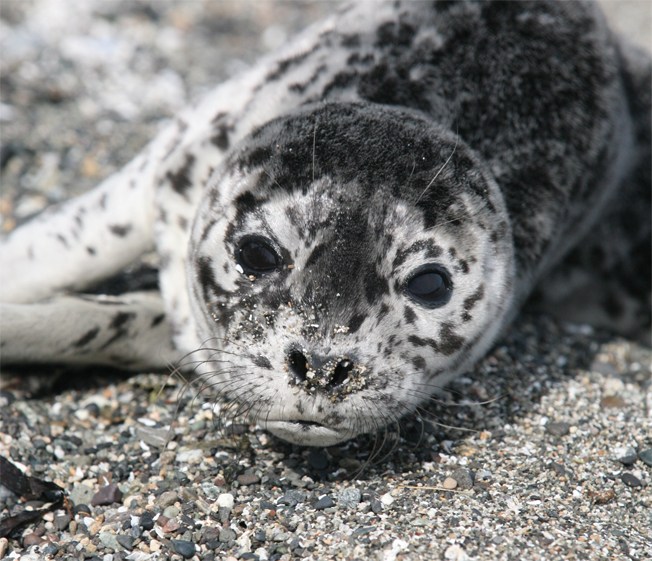
Pacific harbor seals are the most common marine mammal in Puget Sound, and their populations are healthy.
Seals share a common ancestor with dogs and bears and have upper and lower arms and legs concealed within their skin. Only their hands and feet extend outside the body envelope.
Seals have large eyes to see in dark, deep water. They have long necks, which they can shoot out quickly to catch fish while swimming.
Seals can live in fresh or saltwater; they usually spend their entire lives in an area of about five miles.
Baby seals are born weighing about 25 pounds. They double their weight in the first month; their mother's milk is 40 percent fat.
A mother leaves its pup after the first month to finish growing and fend for itself. Mothers do not teach pups to hunt; they learn on their own.
Seals dive for three minutes at a time typically, but they can stay under water as long as 30 minutes and dive as deep as 1,600 feet.
Unlike humans, harbor seals breathe out before diving. They use oxygen already in their blood and muscles while under water, and their heartbeat slows from about 100 beats per minute to 10.
In one breath a seal can exchange 90% of the air in its lungs. Humans can only change 20% of our air per breath.
A seal's whiskers help it hunt and navigate by sensing pressure waves from fish and underwater objects.
Seal-tissue tests reveal elevated levels of PCBs in animals tested in southern Puget Sound. In the north, seal blubber is contaminated with dioxins and furans from paper mills in the Straits of Georgia.
Check out our page on our Harbor Seal Skeleton.
Check out the Harbor Seal Species Profile that SeaDoc wrote for the Encyclopedia of Puget Sound!
Think harbor seals are cool? Learn about more species with our free monthly newsletter!